

Make Your Finish Assessment as Consistent as Your Cutting
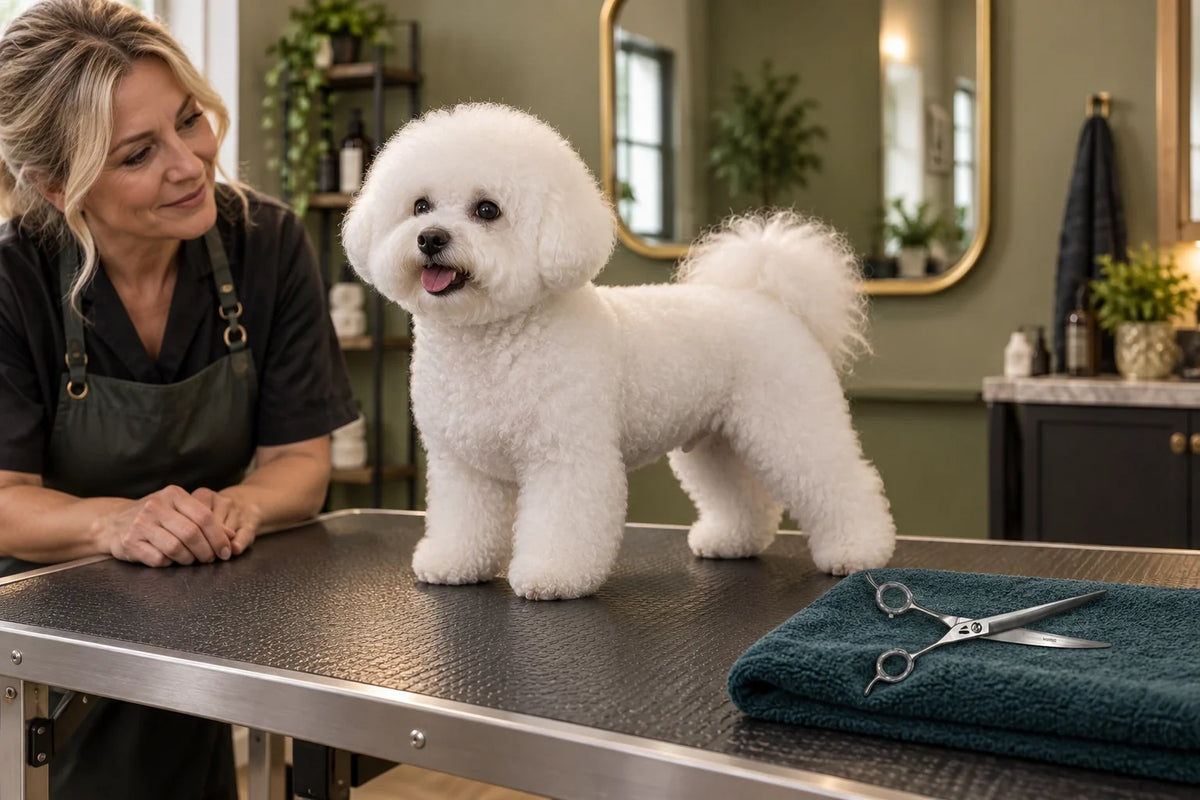
Two groomers can agree that a finish is “almost right” and still mean different things. One is looking at the body-to-leg blend; the other is looking at the silhouette from the front. If the assessment keeps changing, the correction can keep moving too.
Before asking the team to produce more consistent work, make the observation itself more consistent.
A repeatable check is not the same as a complete assessment
NIST's measurement guidance distinguishes short-term variation from variation across days, including changes in environment and handling. It cautions that impressive short-term precision can miss larger day-to-day variation. Grooming photographs and visual ratings are not laboratory calibrations, but the lesson transfers: agreement during one demonstration does not establish reliable agreement under ordinary salon conditions. Read the measurement-variability guidance.
Choose one feature to assess
Replace “finish quality” with a specific question. Is the transition at the upper leg visibly abrupt from the agreed viewing position? Is there a persistent projection beyond the intended foot outline when the dog stands comfortably? Is a visible track still present after the coat is released?
Keep the intended style and the individual dog's anatomy in the description. Consistency does not mean giving every dog the same shape or forcing a stance to match a reference photograph.
Use stable training material for repeated assessment
Choose a small collection of your own photographs, with client permission where needed, or suitable practice work. Include clear examples and some borderline ones. Show the same view at the same size and under similar display conditions.
Ask each groomer to assess the examples independently before discussing them. Later, show the same examples in a different order without the previous answers visible. This is a simple coaching exercise, not a formal validation study.
If one person changes their answer, discuss what they noticed the second time. If different people disagree, ask which feature each was judging. Often the useful improvement is a clearer criterion, not another round of cutting practice.
Keep judgement and correction separate
Decide whether a feature needs attention before choosing a tool. An agreed visible projection might call for a small continuous cut; an abrupt transition may require a different approach. Neither decision should begin with “I have the thinners in my hand, so I will use them”.
The VUNRO Precision Straight Scissors and Precision Curved Scissors serve different cutting lines. Keep the chosen tool, preparation and section presentation in the training note so the correction can be understood, not merely copied.
Once you return to a dog, its comfort and the agreed service remain the limits. Do not repeat trimming on an already acceptable area to test whether a colleague can reproduce your judgement.
Review the check under real working conditions
Look at examples from different days, coat types and lighting conditions. If agreement collapses when the camera angle changes, improve the photography. If a criterion works only for one coat presentation, narrow its scope rather than pretending it is universal.
A useful team note might say: “Assess this transition from the side with the dog standing comfortably and the coat released. Check another view before making a correction.” That gives the next groomer a reproducible observation without dictating a rigid pose.
Our guide to repeatable finished-groom photographs covers the image setup. Together, clear viewing conditions and clear criteria make feedback more useful—and reduce corrections made simply because two people were looking at different things.
Keep learning
More from the Blade Blog
Explore coat care, equipment guidance and practical grooming routines in the complete guide library.
Browse all grooming guides →


